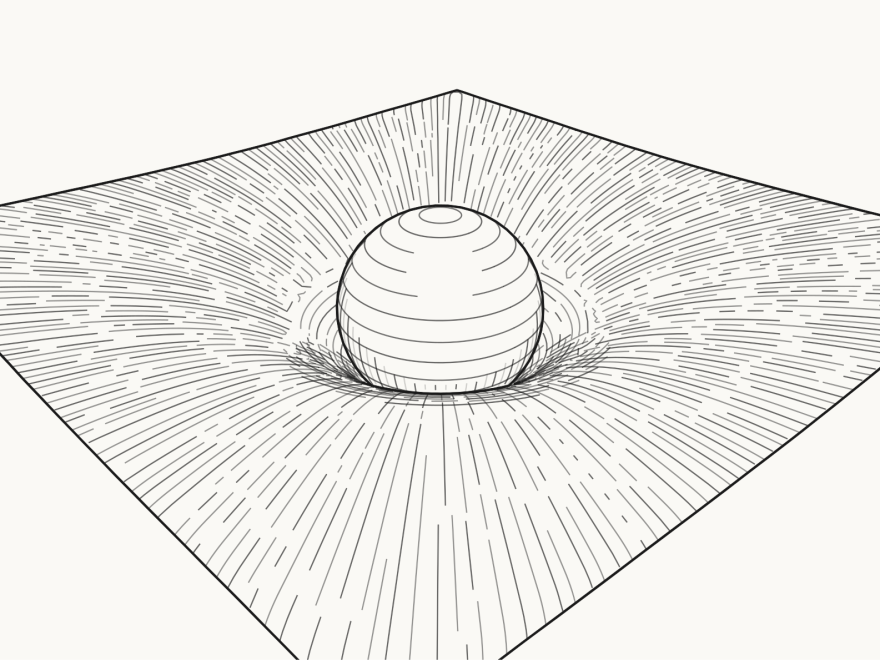
This is not a scan of a pencil drawing. It’s SVG — computed, deterministic, and, in a sense I’ll get to, exact.
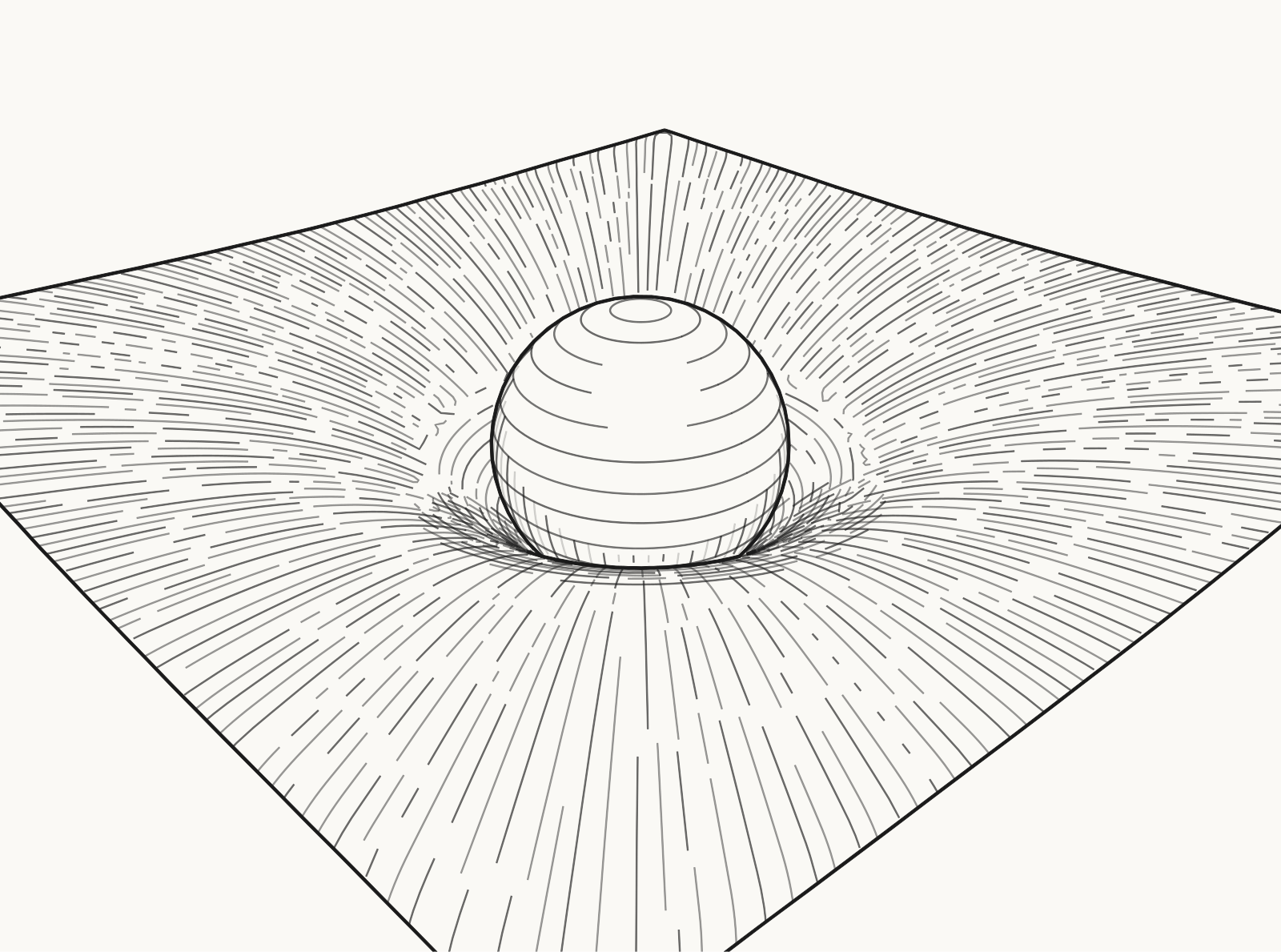
For the past few months I’ve been building Krbn, a small open-source rendering engine that draws 3D scenes the way a technical sketch artist would. It’s a childhood idea. Back then I wanted to call it genesis imperfecta, because what fascinated me was — and still is — the idea of going against photorealism: that a human being conveys more meaning in a drawing than any photorealistic render, precisely by renouncing detail, dropping precision, deliberately introducing imperfections. The catch, of course, is the question hiding inside that sentence: which detail do you drop? Which imperfections do you introduce? That question turns out to be an engineering problem, and a lovely one.
The inversion
Most rendering answers “what color is this pixel?” A pencil drawing answers “which lines would an artist draw — and which would they leave out?” So Krbn has no shading model. It derives strokes from geometry and then applies policies to the stroke set:
- Silhouettes of spheres, cylinders, cones are computed in closed form — they are exact conics; a torus yields its true quartic. No sampling, no meshes pretending to be curves.
- Hidden lines aren’t z-buffered away; each contour is split analytically into visible and ghosted runs, the way a draftsman keeps the far edge of a box faintly alive.
- There is no alpha channel. Cross-hatching is inherently see-through — the gaps between strokes reveal what’s behind, exactly like on paper. And the hatching follows each surface’s own curvature field, so form comes from direction, not gradients.
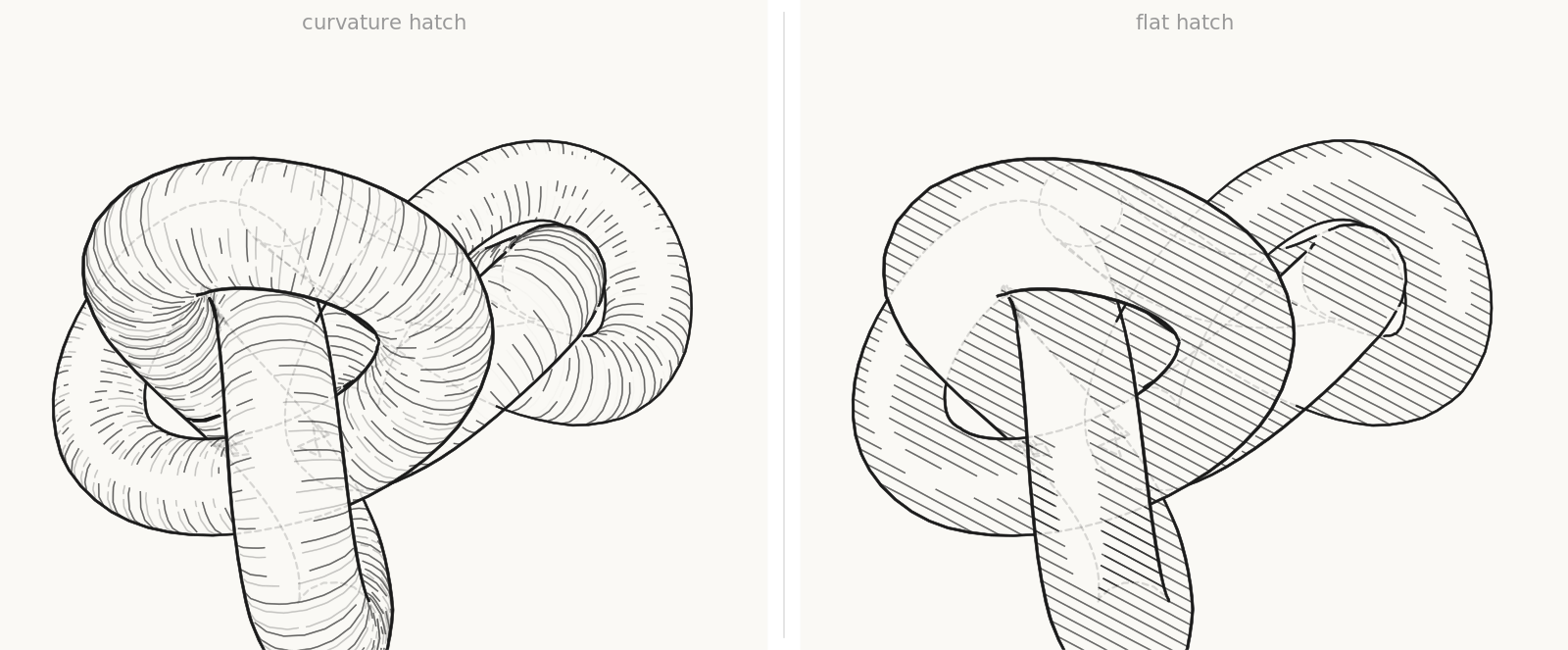
Exactness was a deliberate value, not an optimization: intersections are roots of low-degree polynomials, and the degenerate cases — tangent lines, coincident conics, grazing cusps — are treated as the spec, not as edge cases. The reward is output you can trust: the same scene always emits the same, byte-identical, diffable SVG.
The part stills can’t show
Hand-drawn wobble is easy. Hand-drawn wobble that survives animation is not: re-randomize per frame and the whole drawing “boils”. In Krbn the wobble is seeded on stable stroke identity — each line carries its jitter with it across frames — so an orbiting camera slides the silhouettes while the lines stay calm:
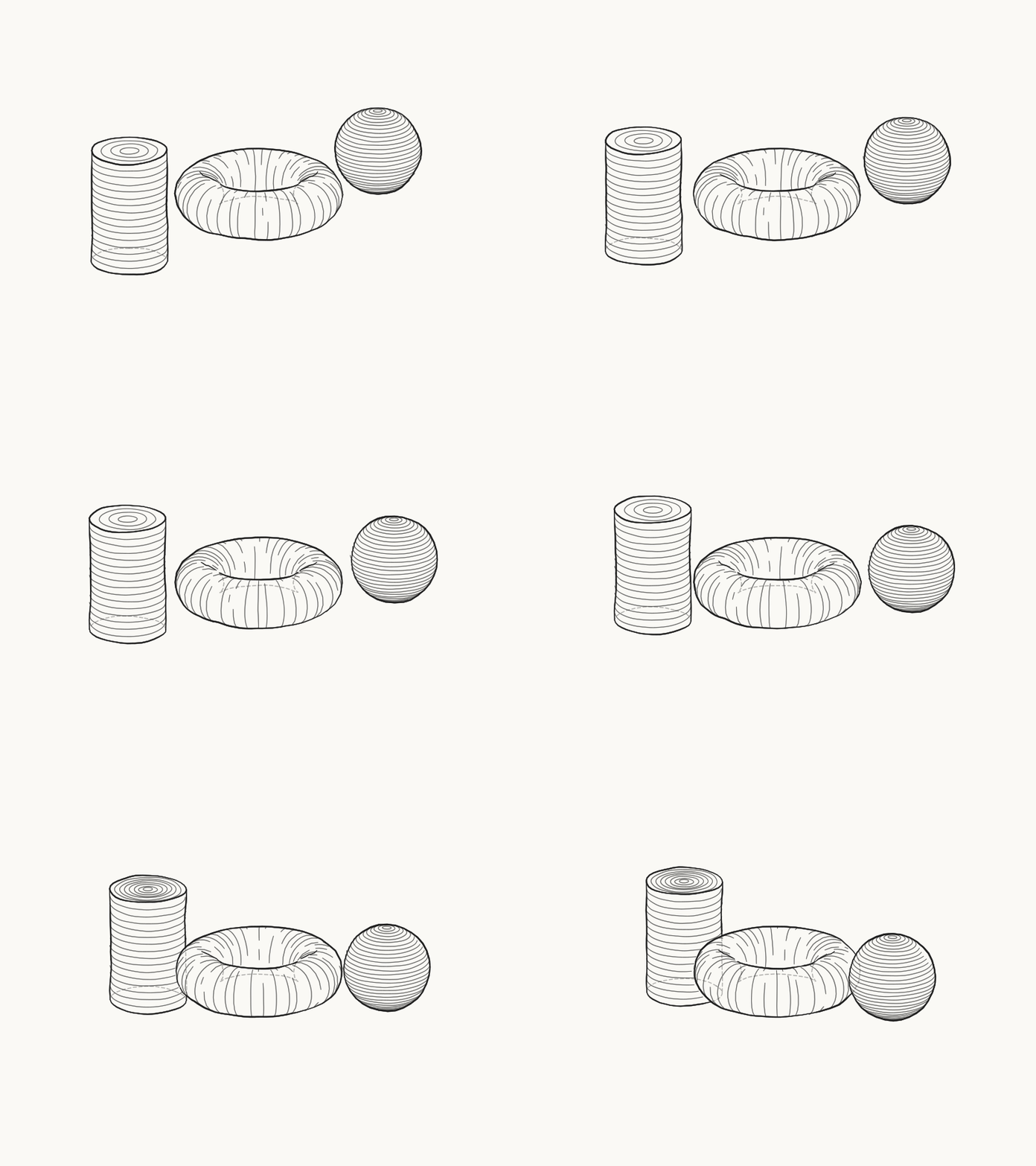
Getting to that calm — persistent stroke identity, hatch that pans with surfaces instead of re-dealing, detail that fades instead of popping — was the hardest part of the project, and my favorite.
The other experiment
I’ll say this plainly, because I put it in the README too: Krbn was built with heavy AI assistance, unapologetically. It doubled as an experiment — how far can a carefully directed human–AI collaboration get on a hard rendering problem? “Carefully directed” is the operative phrase: the architecture, the taste, and the standards are mine, written down and enforced (the working brief and the numerical-robustness rules ship in the repo — judge for yourself). The code was reviewed and tested like any other code. The answer to the experiment, as far as I’m concerned: far. Farther than I expected.
What’s next
Nothing on a schedule — this is a break-time project and I intend to keep it joyful. But the ideas corner is already growing (stippling as an alternate hatch strategy, colored pencils that stay stroke color and never become a fill model, deliberate temporal decoherence à la “Take on Me” by A-ha), and the repo has an example gallery.
If you make technical figures, drive a pen plotter, or just share the fascination — come say hello. Or don’t; all is good. The “pencil” exists now, and 12-yer-old me is happy.
Don't keep it to yourself!…